
The Drone Is Ready. But Are We Really Ready?
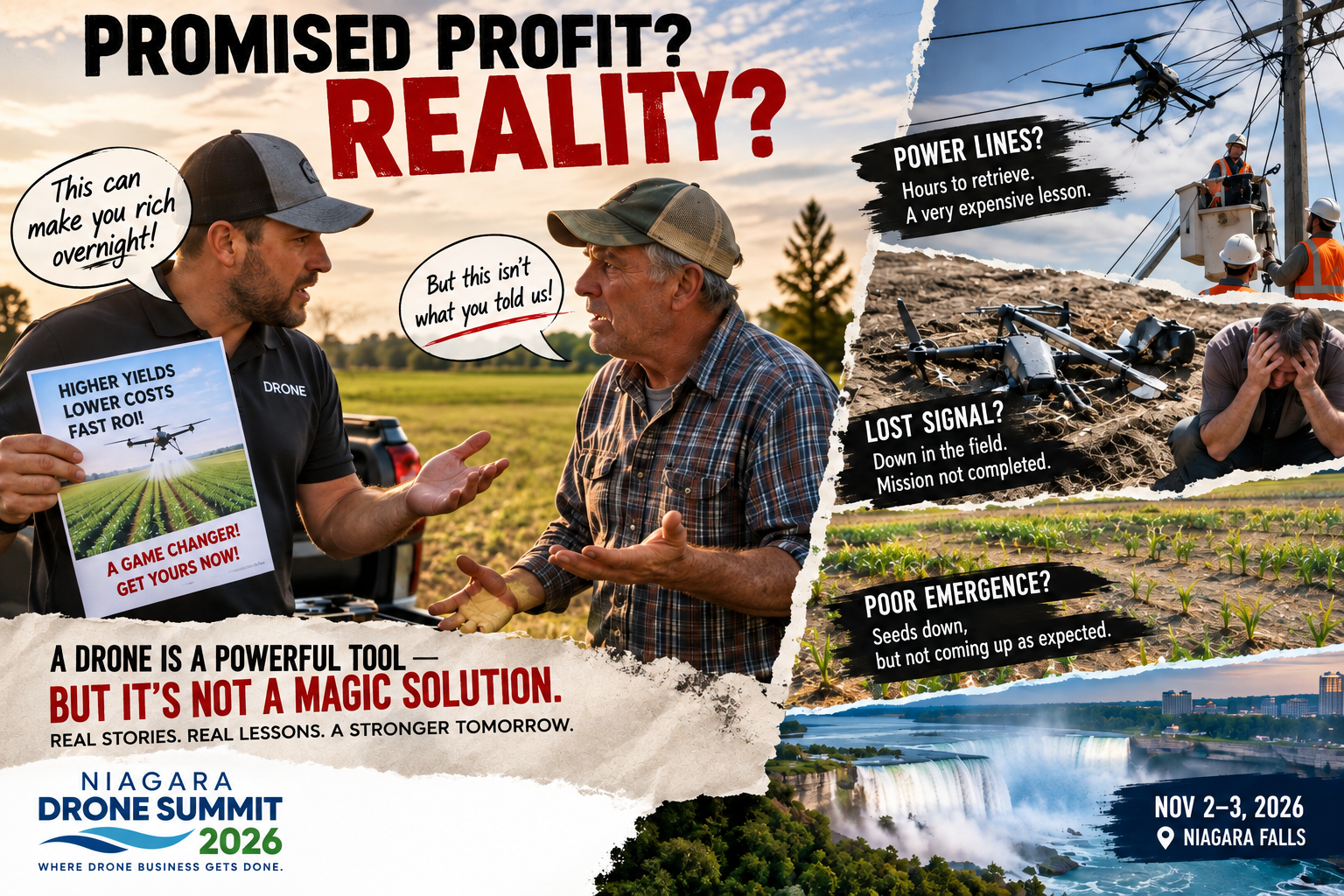
Not long ago, a customer said something to me that I still remember.
He said:
“Jenny, you talk about agricultural drones very differently from the people selling them elsewhere.”
I asked him, “What’s different?”
He said:
“You teach us a lot. You tell us what we need to pay attention to and what kinds of situations can cause problems. But they tell us that once we buy one of these, it can make us rich overnight.”
I laughed when I heard that.
Not because agricultural drones can’t make money.
Quite the opposite. Over the years, we have personally seen many people use agricultural drones to accomplish work that used to be very difficult, and some have genuinely built good businesses around them.
But the more we see, the less comfortable we are making it sound that simple.
Because today’s agricultural drones really are becoming easier to fly.
Automated routes, RTK, terrain following, radar, vision systems, obstacle sensing… once the field and parameters are set, the aircraft can handle a great deal of the work on its own.
That makes it easy to come away with one impression:
Buy a drone, learn how to operate it, and then go out and start making money.
But after the 2026 application season, I increasingly feel that we may be confusing two very different things:
Knowing how to fly a drone and knowing how to successfully complete an agricultural drone operation are not the same thing.
Several stories we heard this year made that distinction especially clear.
A Drone Hanging From a Power Line
Just recently, someone called me and told me about something that happened this summer.
They had hired someone to perform an agricultural drone application.
During the job, the drone struck a power line and ended up hanging from it.
It took a long time before they were finally able to deal with the aircraft and get it down.
If the only damage was a few propellers, they were actually very fortunate.
An agricultural drone, after all, is not a few-hundred-dollar aircraft.
A serious collision can damage motors, arms, ESCs, wiring, or even critical electronic components. If the main board or another important component is damaged, the repair cost and downtime can quickly turn a “small accident” into something much more serious.
But over the years, when I hear about something like this, my first thought is often no longer:
“How much is this drone going to cost to repair?”
I think about the farmer.
Because the farmer didn’t hire an operator to watch a drone fly.
The farmer needed an application completed.
Maybe the fungicide window is only a few days.
The weather is finally right. The crop is at the stage when treatment is needed. The time was booked in advance, the product is ready, the water is ready, and the operator has brought the equipment to the field.
Then the drone ends up hanging from a power line.
What happens to the rest of the field?
If the operator has only one aircraft, can the job continue that day?
Is there a replacement aircraft available?
Does another service provider have time?
What if it rains for the next two days?
What if the best application window has already passed by the time the drone is repaired?
So the loss from a crash does not necessarily stop with the operator.
The operator may see a repair bill; the farmer may lose an application window that will never come back.
That is why I am increasingly reluctant to reduce agricultural drone safety to:
“Be careful when you fly. Don’t crash the drone.”
Ultimately, it can affect the farmer’s crop and the farmer’s return.
PITFALL #1: We May Trust the Aircraft Too Much
After something like this happens, people often ask:
“But doesn’t it have radar?”
This may be one of the easiest misunderstandings to have about modern agricultural drones.
Today’s aircraft really are very intelligent.
Radar, vision systems, terrain following, RTK, automatic route planning, obstacle sensing…
These technologies have significantly lowered the barrier to operation.
So for someone new to the technology, it is easy to think:
If the aircraft is this smart, can’t I just set up the mission and let it fly itself?
But a field is not a laboratory.
A power line does not become thicker just because your drone has radar.
A guy wire does not become easier to detect because obstacle sensing is turned on.
Tree branches, terrain, crop height, and field conditions will not always look exactly the way they did on the map.
So the real question is not:
“Does this aircraft have obstacle avoidance?”
The real question is:
“Does the operator understand when that system may not see something?”
Those two questions sound similar, but the capabilities behind them are completely different.
Automation can help an experienced operator.
But automation cannot replace experience itself.
Another Drone Suddenly Lost Its Signal
Another type of incident stood out to me this year.
The aircraft had been operating normally. Then it suddenly lost its signal and eventually came down in the field.
When people hear about something like this, the first reaction is often:
“How could the drone suddenly do that?”
But this is exactly where I think training is most often misunderstood.
Someone may know how to map a field, set the acres, adjust the flow rate, press Start, and let the aircraft complete an automated mission.
Of course, we can say that person “knows how to use it.”
But that does not necessarily mean the operator truly understands:
How does the aircraft maintain communication with the controller?
What terrain or environmental conditions can affect the signal?
What logic does the aircraft follow after communication is lost?
When does it continue the mission?
When does it Return-to-Home?
Is the RTH route safe?
If the aircraft stops and hovers, communication does not return, and the battery keeps dropping, what might happen next?
These things can sound almost boring when everything is working normally.
When the drone flies perfectly every day, you may think you will never need to know them.
Until those ten or fifteen seconds actually happen.
At that moment, the person who understands why the aircraft is behaving that way may react very differently from someone who only knows how to make the aircraft start working.
PITFALL #2: We Confuse “Knowing How to Operate It” With “Understanding How It Works”
That is why, over the years, I have always felt that the most important part of agricultural drone training should not simply be teaching someone how to complete a normal mission.
Normal missions are actually the easiest part to teach.
What deserves the most attention is:
“What do I do when something abnormal happens?”
What happens if the signal is lost?
What happens if there is a GNSS abnormality?
What happens if the aircraft stops in front of an obstacle?
What happens if terrain following does not behave the way you expected?
What happens if the battery drops faster than expected?
What happens if there is a power line along the RTH route?
This is not about memorizing dozens of pages from a manual.
The operator needs to understand:
Why is the aircraft doing this, and what is it going to do next?
Only when you understand that can you know what you should do next when something abnormal happens.
Another Story This Year: The Seed Was Spread. So Why Didn’t the Crop Emerge Properly?
This year, quite a few people contacted us about something that had nothing to do with a crash.
Their drones did not hit a tree.
They did not end up on a power line.
There was not even an obvious equipment failure.
The drone followed the planned route and spread the seed.
The controller showed that the mission was completed.
But some time later, when people went back to the field, the problem became visible:
Emergence was good in some areas, poor in others, and noticeably uneven in certain parts of the field.
That story made me think for a long time.
Because it shows us a completely different kind of risk in agricultural drone operations:
The aircraft returning safely does not necessarily mean the job was successful.
What the farmer ultimately cares about is not whether the controller displayed:
Mission Completed.
What the farmer really cares about is:
What came up in the field a few weeks later?
Spreading itself is a system.
Different seed sizes, weights, and shapes behave differently. Changes in application rate, flight speed, flight height, spinner speed, effective swath width, wind, and field conditions can all change what ultimately reaches the ground.
So sometimes we say:
“The seed has been spread.”
But the farmer’s real question should be:
“Was the seed spread correctly?”
Those are not the same thing either.
PITFALL #3: We Focus on the Drone and Forget the Result of the Job
Spraying is the same.
Over the years, the things people most often like to compare are:
How big is the tank?
How many litres per minute?
How many acres per day?
How quickly can the battery recharge?
How fast can the aircraft fly?
Of course these things matter.
But what the farmer ultimately purchases is not acres per hour.
The farmer is purchasing the result of an application.
If 200 acres are completed very quickly but the coverage is wrong, “finished” does not mean very much to the farmer.
Did the product actually reach where it needed to go?
Was the coverage uniform?
Were areas missed?
Was the droplet size appropriate?
Was the swath width reasonable?
Were height, speed, flow rate, and wind conditions properly matched?
The same applies to spreading.
The fact that the drone released the seed only proves that the aircraft completed the mission.
Whether the seed was spread correctly is something the crop will tell you later.
So as agricultural drones move from being a “cool new piece of equipment” to becoming real agricultural production tools, the way we judge whether a job was successful also has to change.
The question cannot simply be:
Did the drone finish flying?
It should be:
Did this application actually deliver the result the farmer needed?
PITFALL #4: We Calculate the Drone’s ROI, but Rarely Calculate What Downtime Costs the Farmer
Go back to the drone hanging from the power line.
If it ultimately costs only a few hundred dollars to repair, it is easy to say:
“That wasn’t too bad.”
But for the farmer waiting for the application to be completed, is that really true?
Agriculture is different from many other industries.
If a machine cannot be repaired today, perhaps it can be repaired tomorrow.
But the crop does not stop growing for three days because the drone is broken.
Disease pressure does not wait for parts to arrive from the warehouse.
The weather window does not automatically extend because an accident happened today.
When we talk about agricultural drone ROI, we often calculate:
How many acres can it cover in a day?
How much can you charge per acre?
How many acres can you complete in a season?
How quickly can the aircraft pay for itself?
Those are all valid numbers.
But there is another number that rarely appears on a beautiful ROI spreadsheet:
What does downtime cost?
For the service provider, it is downtime.
For the farmer, it may be the crop.
That is why safety, training, and support are not optional extras outside the aircraft — things that are nice to have but not essential.
They are part of the service the farmer is ultimately paying for.
PITFALL #5: The Question We Most Often Forget to Ask When Buying the Aircraft
When people buy a drone, they usually ask very detailed questions.
How much does it cost?
How much discount can I get?
How many batteries?
How long does charging take?
How many acres per day?
How big is the tank?
What is the flow rate?
But when July or August arrives and everyone is at their busiest, one question can suddenly become more important than every specification above:
“Something has gone wrong. Who do I call?”
And ideally, that should not be a question you ask for the first time while the aircraft is sitting in the field.
Agricultural drone support should not simply mean:
“If it breaks, we can sell you the parts.”
Real support means having someone who can help the operator determine:
Is this an aircraft problem, or is it related to the operating environment?
Should the mission continue, or should it stop?
What does this warning actually mean?
Is this behaviour normal?
After the aircraft is repaired, why did this happen?
How can it be prevented next time?
So when choosing an agricultural drone, perhaps in addition to asking:
“How much does this aircraft cost?”
We should also ask:
“When things do not go according to plan, who is going to help me?”
So, Is an Agricultural Drone Really a “Get Rich Overnight” Machine?
That brings me back to what that customer told me at the beginning of this article.
Can agricultural drones make money?
Of course they can.
Over the years, we have seen many operators and farmers use them to accomplish extremely valuable work, and we have seen people genuinely build businesses around them.
But if the question becomes:
“Can I buy one, learn a few basic operations, and then start making money consistently?”
I would be much more cautious.
Because the 2026 application season has reminded us once again:
A good drone is only one part of the system.
The crop emerging in the field.
The aircraft hanging from a power line.
The drone that lost its signal and came down in the field.
And the farmer who had already scheduled the job and was waiting for the application to be completed.
These may look like completely different situations.
But underneath, they are all telling us the same thing:
Agricultural drones are becoming easier to fly.
But completing an agricultural drone operation professionally still requires knowledge, experience, judgement, and support.
And That Is Exactly Why We Decided to Bring These People Together
After hearing these stories this year, we kept coming back to one question.
Why, after so many years of industry development, do we still wait until a drone crashes, the crop emerges unevenly, or a farmer misses an application window before we sit down and talk about these problems?
Eventually, I began to think that perhaps the industry does have many of the answers.
The answers are simply scattered among different people.
The manufacturer understands the aircraft.
The dealer sees all kinds of technical problems every day.
The operator knows what actually happens in real fields.
The researcher studies coverage, deposition, drift, and efficacy.
The trainer knows where new operators most often misunderstand the aircraft.
And the farmer understands one thing better than anyone:
Whether the result that eventually appears in the field was worth the money.
At many events, manufacturers talk about what manufacturers know, dealers talk about what dealers know, and researchers talk about what researchers know.
Then the event ends, everyone packs up their banners and goes home.
The operator goes back to the field and still has to face the real problems alone.
So this time, we want to try something a little different.
That is why we decided to organize Niagara Drone Summit 2026.
We want to bring these people together.
Not so everyone can take turns standing on a stage telling us how good their product is.
But so we can put the problems that actually happened in the field this year on the table.
Why was the seed spread, but emergence was still uneven?
Why can an aircraft with obstacle sensing still hit a power line?
Why might an operator who already knows how to fly still not know what to do when the signal is lost?
How do we know an application was truly completed — rather than simply seeing Mission Completed on the controller?
We may not solve every problem in the agricultural drone industry in two days.
But at the very least, someone who has already learned a difficult lesson can share that experience with someone who has not encountered it yet.
Because farmers should not have to pay again for lessons the industry has already learned.
In 2026, agricultural drones in Canada are reaching a very interesting point.
The aircraft are becoming more mature.
More farmers and service providers are beginning to treat them as genuine production tools.
That represents a tremendous opportunity.
But the real stories from this season have also given us a simple reminder:
Just because agricultural drones are becoming easier to fly does not mean agricultural drone operations require less experience.
If you are already using agricultural drones this year, perhaps you have a story of your own.
If you are considering your first aircraft, perhaps there are a few questions worth asking before “How much does it cost?” and “How many acres can it do in a day?”
And if you have been working in this industry for several years, we hope you will bring your real experience with you.
November 2–3, 2026
Niagara Falls Convention Centre
Niagara Falls, Ontario
We want to bring farmers, operators, service providers, manufacturers, dealers, trainers, researchers, and application experts into the same place.
Not because we already have all the answers.
But because the industry has reached the point where it is time to bring those answers together.
Niagara Drone Summit 2026
Real drones. Real fields. Real experience.
Niagara Drone Summit 2026 — November 2–3, Niagara Falls, Ontario
Farmers, operators, researchers, manufacturers, dealers and application experts — bring your experience to the conversation.
Founding Registration is now open through September 24.
REGISTER / LEARN MORE
Organized by
WONDERFULL TECH.
Transport Canada Recognized RPAS Flight School
Certified Advanced Flight Reviewer
Drone Compliance | Academy Training (DJI Standard) | Sales & Service
Office: 647-800-7952
Mobile: 647-287-6851
5955 10 Sideroad
Innisfil, ON L0L 1K0
Canada